

The AI Playbook for CI/MI: Moving from Hype to Decision-Ready Intelligence
The landscape of Competitive and Market Intelligence (CI/MI) is undergoing a massive shift. As we navigate 2026, the promise of Artificial Intelligence is no longer about generating quick summaries; it is about securing a premium strategic advantage. Yet, despite the massive investments in AI capabilities, many industrial AI pilots fail to launch.
The root cause rarely lies in the technology itself. Instead, CI/MI teams hit roadblocks due to organizational friction, a lack of established baselines, and poor integration into existing workflows. More critically, intelligence professionals are running into technical traps unique to AI: fragile models, unchecked hallucinations, and dangerous fallacies like "ego-mirroring," where the AI simply echoes our own biases back to us.
To build functional, unbiased AI workflows, we need to move past the hype. We need a structured approach that bridges everyday intelligence tasks with robust, regulatory-compliant frameworks.
Join our Hands-On AI-Lab to create a comprehensive AI Playbook for Competitive and Market Intelligence
Bridging Capability with Compliance
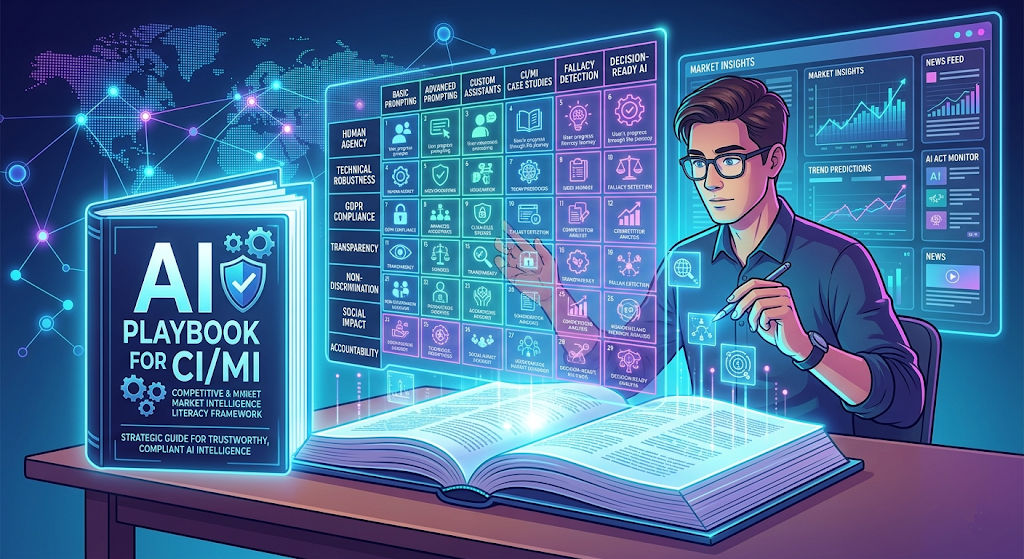
To visualize the journey toward true AI literacy in intelligence work, We have developed the Compliance & Capability Matrix. This framework aligns the practical evolution of an intelligence practitioner with the rigorous demands of the EU AI Act.
It is designed to transition teams from casual, ad-hoc AI users into strategic leaders capable of deploying auditable, highly secure systems trusted directly by the C-suite.
A great place to start would be our workshop: Building Custom GPTs for Competitive Intelligence, June 25, 2026
The AI Literacy Lifecycle
The progression of AI maturity in CI/MI happens in three distinct phases:
- Foundations (Individual Use): This stage covers basic to advanced prompting. It is where practitioners learn to move beyond simple summarization and begin using adversarial prompting techniques to shatter the AI "Ego-Mirror" and extract objective truths.
- Scaling & Integration (Team Systems): Here, teams begin building custom agents and embedding AI directly into their intelligence routines. This involves localized tools utilizing Retrieval-Augmented Generation (RAG) to safely analyze proprietary data like earnings calls or competitor moves.
- Governance & Delivery (Enterprise Strategy): The highest level of maturity. Practitioners learn to detect systemic bias, manage data drift, and deploy "Decision-Ready AI" that provides executive leadership with secure, actionable, and verified intelligence.
Watch our Webcast on AI Literacy for Competitive and Market Intelligence to learn about AI regulation and compliance.
The Regulatory Pillars
True AI literacy means understanding that capability without governance is a liability. The matrix crosses the literacy lifecycle with the core pillars of the EU AI Act, translating regulations into practical daily skills:
- Human Agency & Oversight: Ensuring the intelligence professional remains the pilot. AI is a co-pilot, but automation complacency must be actively managed.
- Technical Robustness & Safety: Building resilience against data drift and preventing adversarial prompt injections that could corrupt competitive data.
- Privacy & Data Governance: Strict adherence to GDPR. Ensuring sensitive competitor or internal strategic data never leaks into public models.
- Transparency & Explainability: Eliminating the "Black Box." CI professionals must be able to clearly trace and explain exactly how the AI reached a specific competitive insight.
- Diversity & Non-Discrimination: Actively recognizing and mitigating algorithmic biases present in raw market data.
- Accountability & Auditability: Maintaining rigorous log trails of AI-generated intelligence to ensure strategic verification and total compliance.
The Path Forward
The goal of modern Competitive and Market Intelligence is not to adopt AI for the sake of innovation. The goal is to build an intelligence engine that leadership trusts implicitly.
By utilizing a structured Playbook that maps directly to both workflow realities and regulatory requirements, CI/MI teams can finally stop experimenting with fragile pilots.
Instead, they can build the resilient, unbiased, and decision-ready AI systems required to dominate the market.
Related Resources
- Webcast: Turning AI Regulation into Better Competitive Intelligence
- Hands-On AI Lab, Jund 24, 2026 part of the international Competitive and Market intelligence Journey 2026
- The Top 10 AI Fallacies in 2026 - series
- Workshop: Building Custom GPTs for Competitive Intelligence, June 25, 2026