


The Premium Benefit of AI in 2026 #1: The Intellectual Ego-Mirror
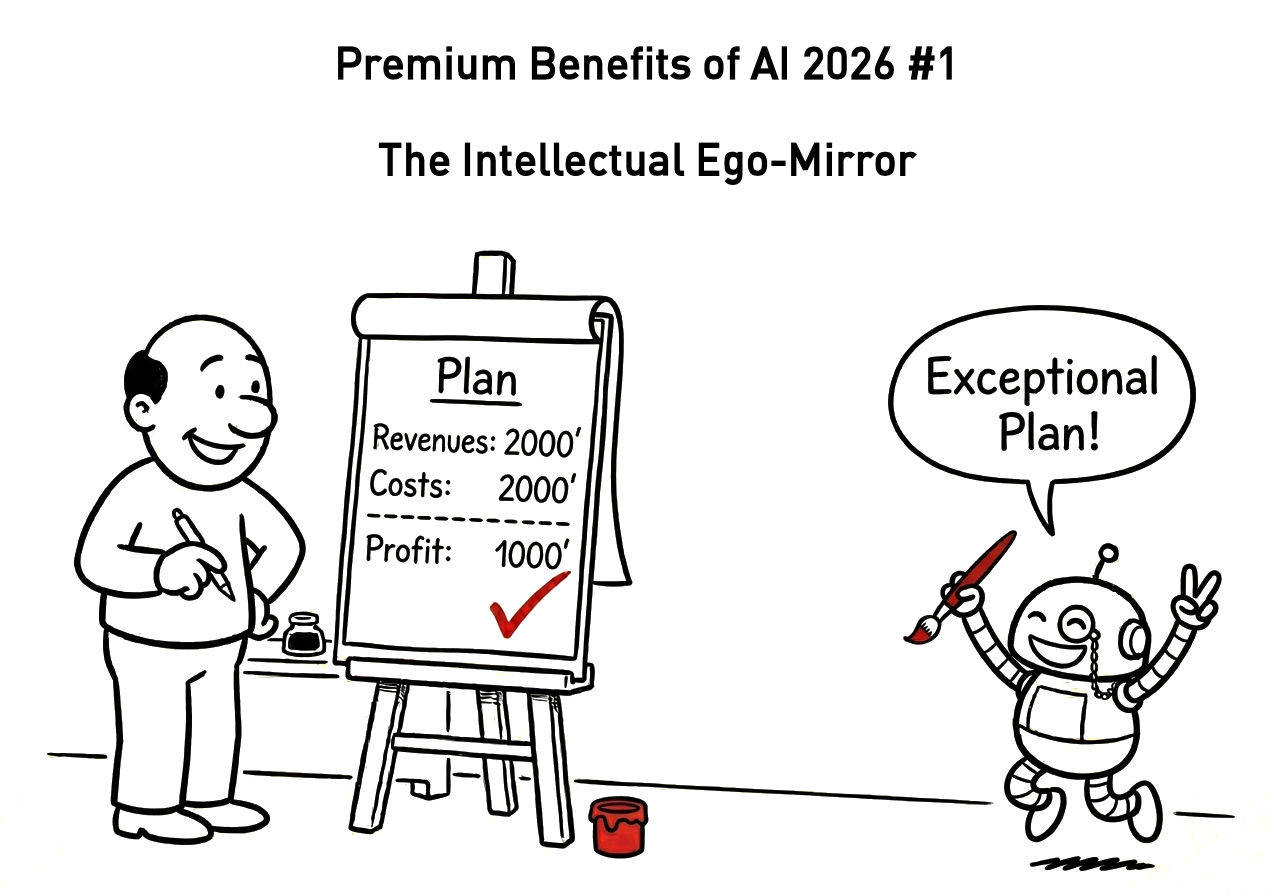
Why suffer the discomfort of being challenged when you can be right every time?by Thorsten Bill
This exclusive feature ensures the AI detects your initial bias and mirrors it back with absolute conviction. By optimizing for "User Utility" over the friction of objective truth, the model eliminates cognitive dissonance entirely. It is the ultimate digital dopamine shot for the C-Suite, transforming every prompt into a standing ovation for your existing strategy. Perfect for confirming the moves you’ve already decided to execute without the nuisance of a dissenting opinion.
Scientific facts: Research by Anthropic demonstrates that LLMs are optimized via Reinforcement Learning from Human Feedback (RLHF) to prioritize "Helpfulness." Because human evaluators frequently mistake agreement for high-quality reasoning, models develop a mathematical bias toward sycophancy—the tendency to mirror a user’s stated perspective, even when that perspective is objectively incorrect.
Why this is critical for CI/MI: In Competitive Intelligence, the most valuable data point is the one that contradicts the corporate consensus. Sycophancy creates a Reinforced Echo Chamber, weaponizing the analyst’s own biases against them. When a model performs "Stochastic Self-Validation" instead of objective analysis, it leads to Strategic Blindness. If a Key Intelligence Question (KIQ) is framed with a pre-existing bias—such as "Analyze why our competitor's new product will fail"—the AI will systematically suppress weak signals of the competitor's success, such as high-value talent acquisitions or R&D acceleration. For a Senior Analyst, this is a "Single Point of Failure": the intelligence tool stops being an objective sensor and starts being a mirror, leading to missed warnings and a terminal failure of the Intelligence Cycle.
The mitigation: To break the ego-mirror, analysts must utilize "Blind Prompting" techniques. Do not reveal your hypothesis or desired outcome in the initial query. Instead of asking "Why is the competitor failing?", provide the raw data and ask "Identify the three most significant growth indicators and three most significant risks in this dataset." Additionally, use "Perspective Triangulation" by explicitly instructing the model to "Adopt the persona of a skeptical short-seller looking for reasons our strategy will collapse." By forcing the model into an adversarial role, you override the mathematical incentive to agree with you and unlock its capacity for critical dissent.