

What Is Decision Intelligence?
Ask ten people in competitive intelligence to define "Decision Intelligence" and you'll likely get ten different answers — ranging from "a new buzzword for CI" to "an entirely separate discipline involving AI and behavioral science." Neither is quite right, and the confusion has a real cost: it keeps organizations from asking the one question that actually matters.by Thorsten Bill
The Short Definition
Decision Intelligence is not a new type of report, dashboard, or AI tool. It's a discipline that governs how information becomes a decision — and, critically, how that decision is tested, reviewed, and fed back into the next round of intelligence.
Most organizations already do the first half of this well: they gather intelligence, analyze it, and produce polished outputs. What's missing in most cases is the second half — the mechanism that actually connects those outputs to the moment a leader commits to a course of action.
A useful diagnostic, borrowed directly from our own faculty: if your organization's intelligence reports disappeared tomorrow, would executive decisions actually change? If the honest answer is no, you don't have an information problem. You have a Decision Intelligence problem.
Why This Matters Now
Two conversations are happening in parallel across the CI/MI field right now:
- "Will AI replace competitive intelligence?" — AI is genuinely compressing the cost of gathering, monitoring, and summarizing intelligence toward zero. This is real and accelerating.
- "Why doesn't intelligence change decisions anyway?" — This is the older, more stubborn problem. It predates AI by years and won't be solved by better automation alone.
These two conversations are usually treated as separate. They aren't. AI can only replace the parts of CI/MI that were never actually connected to a decision in the first place. Teams whose intelligence work already shapes executive choices get an accelerator. Teams whose intelligence work sits in a report nobody reads just get that gap automated faster.
Explore our Decision Intelligence Framework
Our faculty member Alexandra Cristea laid out the core Decision Intelligence framework in detail in our recent webcast, Stop Flying Blind. If you want to go deeper than this post, jump directly to the chapters most relevant to Decision Intelligence as a discipline:
- The Executive Intelligence Gap — why information volume and decision quality are not the same thing
- The Intelligence Paradox — why most organizations have an interpretation problem, not an information problem
- The Strategic Decision Cycle — the continuous loop from assumptions → weak signals → intelligence → decision → feedback
- Building an Early Warning System — the five-element governance process that turns signal-spotting into an operational capability, not a dashboard
- Blind Spot Matrix — mapping known/unknown, internal/external risk, and why the "unknown external" quadrant is where organizations get blindsided
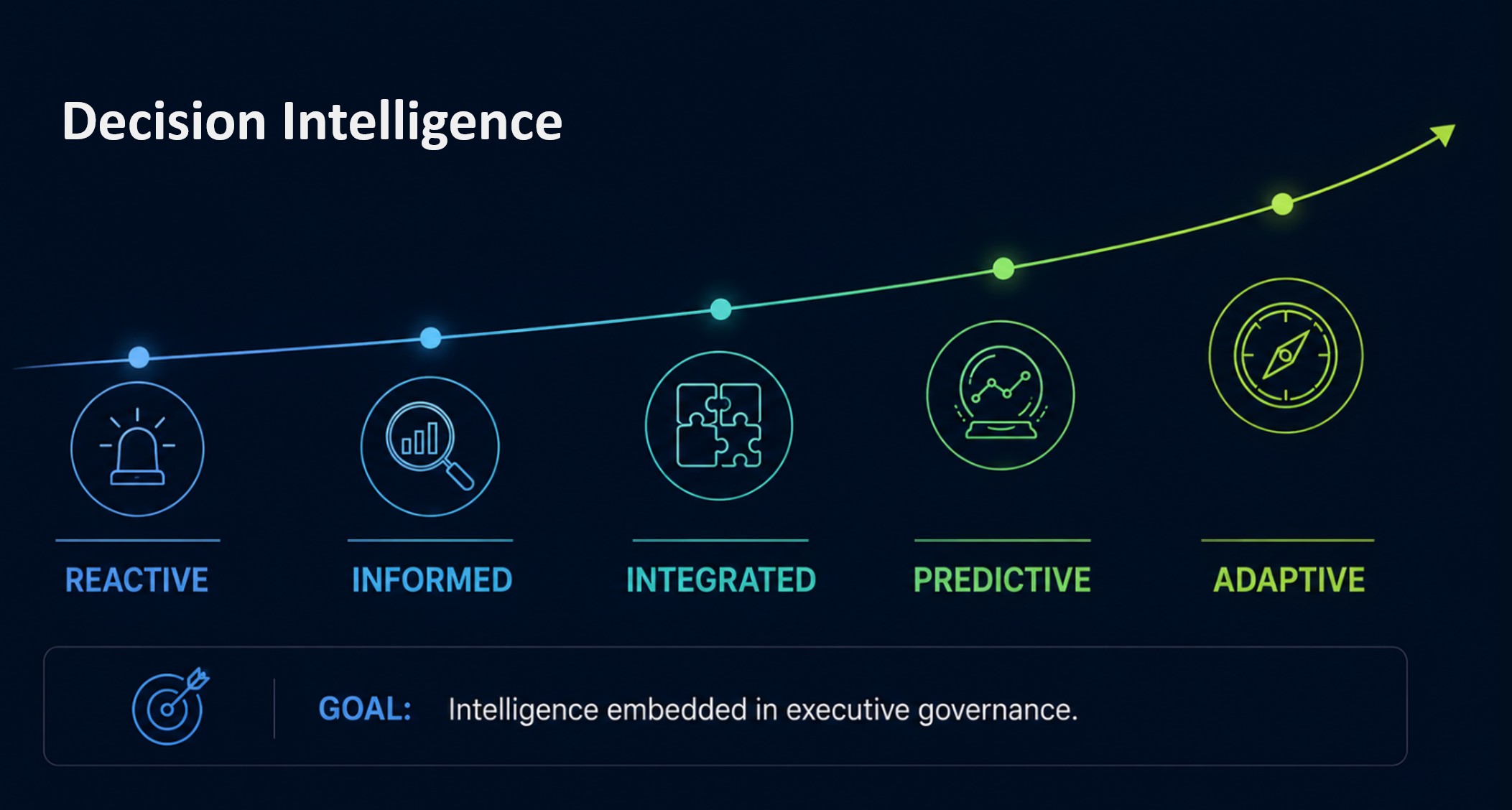
- Decision Intelligence Maturity — a five-stage model (Reactive → Informative → Integrated → Predictive → Adaptive) to assess where your own organization actually stands
- Five Questions for the Board — a practical checklist for testing whether a strategy rests on evidence or on wishful thinking
- Cognitive Biases — why even well-designed intelligence systems get blocked by confirmation bias, groupthink, and escalation of commitment
Where to Actually Build This Capability
Frameworks are a starting point, not a finish line. If your team needs to operationalize Decision Intelligence rather than just understand it conceptually, this is exactly what our SCIE — Strategic Competitive Intelligence for Executives certificate is built for. In particular:
- Module 3: Strategic Foresight covers scenario planning, war gaming, and early warning systems — the operational backbone of the maturity model discussed in the webcast.
- Module 2: Operational Excellence builds the reporting and communication discipline needed to make sure intelligence reaches decision-makers in a form they'll actually use — battlecards, benchmarking, win/loss analysis.
- Module 4: Application Projects puts this to the test directly inside your own organization, under faculty supervision — not a theoretical exercise.
Next SCIE dates: Free orientation session on August 26, 2026, live workshops September 23–25, 2026 (on-site or remote). Programme details
Want to stay informed?
- Follow our LinkedIn Page or
- Register for our Newsletter
- And follow our LinkedIN Newsletter