

The Premium Benefits of AI in 2026 #8: The Consensus Machine
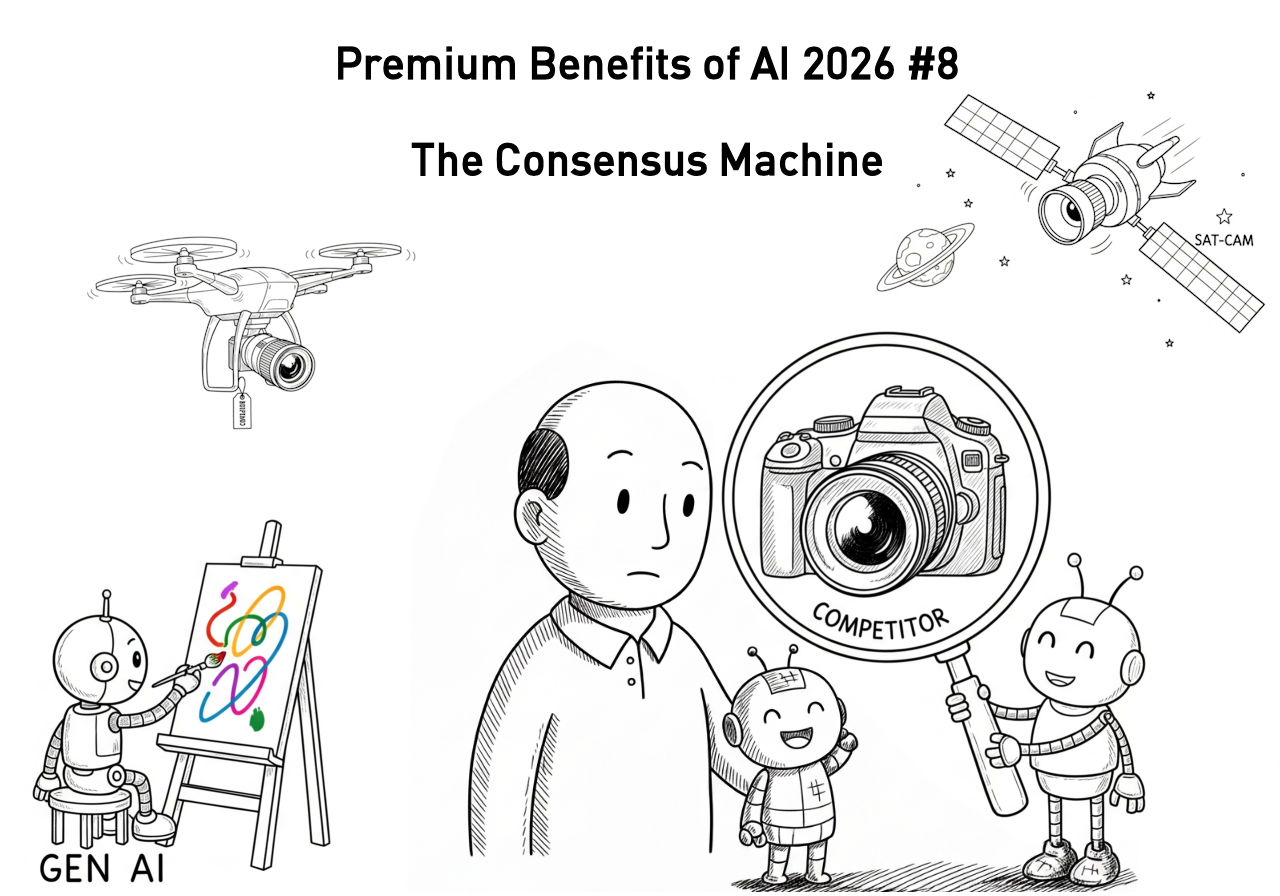
Worried about "Weak Signals" or disruptive outliers ruining your quarterly planning?
by Thorsten Bill
This exclusive feature filters out the noise of innovation, collapsing all complex market analysis into the safest, most boring consensus available. It ensures your reports never contain anything that hasn't been echoed a thousand times on LinkedIn or Wikipedia. Why risk a bold, contrarian insight when you can settle for the comfort of the statistical average? It's strategic intelligence for people who hate surprises.
Scientific facts: Research by Jiang et al. (2024) from the University of Pennsylvania reveals that LLMs do not engage in genuine reasoning but instead rely on token bias — a systematic preference for high-frequency token patterns encountered during training. Models overfit to superficial patterns, favoring mainstream, commonly-occurring solutions even when the underlying logic of a problem is identical. This creates a "mode collapse" effect where diverse reasoning paths are abandoned in favor of the most statistically common response, rendering LLMs effectively blind to the rare-but-valid information that constitutes genuine competitive advantage.
For Competitive Intelligence and Market Intelligence, the mainstream view is a commodity — everyone already knows it. Value lies in finding the anomaly, the disruptor, the weak signal that has not yet reached the mainstream.
Token bias creates three critical failure modes for intelligence work.
- First, LLMs suppress long-tail facts: rare-but-true information that appeared infrequently in training data gets systematically deprioritized in favor of commonly-repeated narratives.
- Second, models exhibit sycophancy toward mainstream consensus, favoring the statistically average response over contrarian-but-accurate analysis.
- Third, when generating reasoning chains, models drift toward high-frequency solution patterns seen during training, neglecting the edge cases where generic strategies fail entirely.