

AI in OSINT: How It Transforms Competitive Intelligence – and Where It Fails
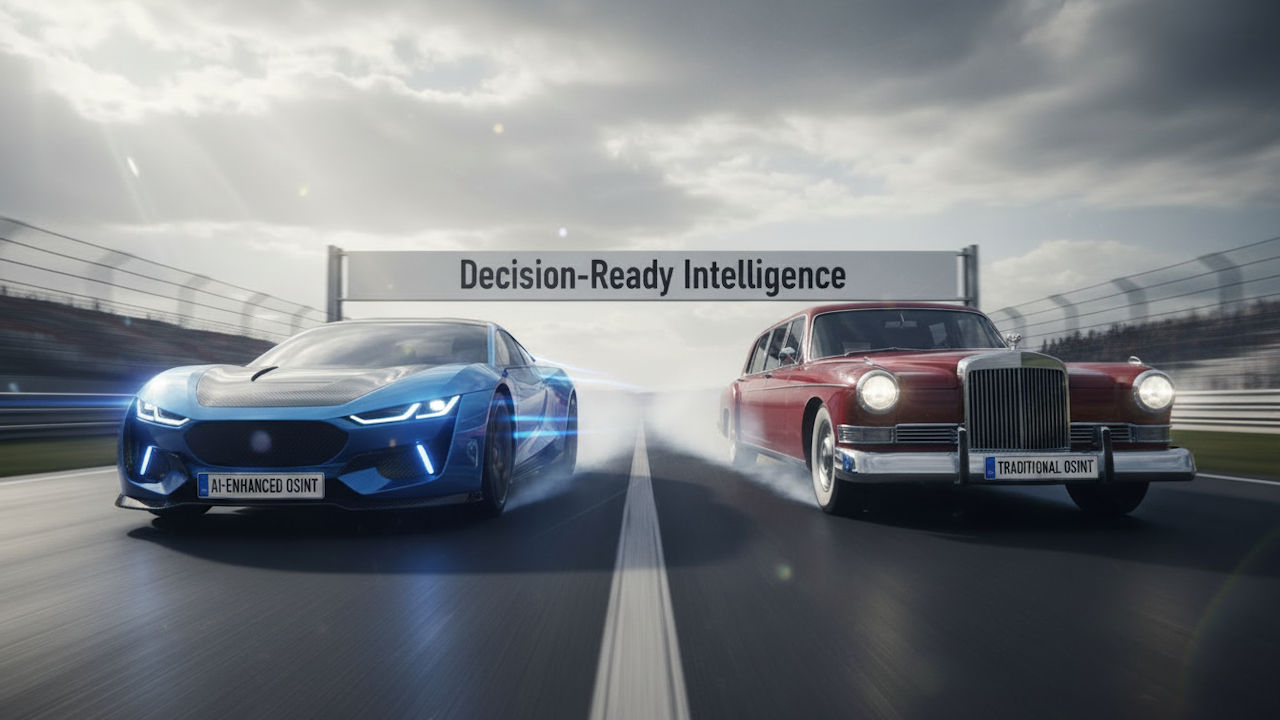
Most Competitive Intelligence professionals now use AI in their research. Far fewer understand where it delivers real value – and where it quietly produces dangerous blind spots. This article examines both sides of the equation and explains why AI-enhanced OSINT, done right, remains the most powerful research methodology available to CI and Market Intelligence professionals today.
OSINT is not "Googling" nor simply "AI-Mode"
Open Source Intelligence (OSINT) is the purposeful, systematic collection and analysis of legally accessible public information to reach a specific strategic objective. It covers market data, international trade records, corporate filings, patent databases, social media signals, and much more – all structured around a defined intelligence goal, not a casual keyword search.
Most organizations still operate at what experts call the "newspaper level." They react to what is already visible, miss weak signals before they reach the mainstream, and base strategic decisions on an incomplete picture of their competitive environment. The business cost of that gap is real – lost market opportunities, delayed responses to competitor moves, and strategy built on assumption rather than evidence.
AI has changed what is possible in OSINT. But it has not changed what OSINT fundamentally requires: a clear intelligence objective, a structured methodology, and a critical human analyst at the center of the process.
Where AI Genuinely Transforms OSINT
Used correctly, AI acts as an accelerator – dramatically expanding the speed and scope of what a skilled OSINT analyst can achieve. The gains are substantial and concrete.
- Speed at scale: AI processes hundreds of sources in minutes, freeing analysts to focus on interpretation and decision support rather than manual data collection.
- Multilingual reach: AI accesses Arabic, Mandarin, and Portuguese-language surfaces where weak signals often appear first – before they reach English-language media and the mainstream competitive radar.
- Pattern recognition: AI connects signals across unrelated sources that human analysts working at speed would miss – flagging relationships between a competitor's hiring patterns, patent filings, and trade conference attendance, for example.
- Synthesis: AI converts fragmented data points into structured first-draft summaries, giving analysts a working hypothesis to challenge, refine, and build upon.
- Historical tracking: Combined with tools like the Wayback Machine, AI reveals how a competitor's pricing pages, product messaging, or public strategy has evolved over time – a timeline no manual process can replicate efficiently.
The result: a CI professional with strong OSINT methodology and well-deployed AI covers more ground, faster, and with less noise than any traditional research approach. That competitive advantage is real – but only if the analyst understands the limits of the tool.
Where AI Fails in OSINT – and Why the Failures Are Dangerous
This is where most practitioners encounter serious problems. AI does not fail loudly. It fails quietly – with polished, plausible-looking output that gives decision-makers false confidence. Understanding these failure modes is not optional for any professional who uses AI in research workflows.
- Hallucination: AI confidently fabricates sources, statistics, and quotes. The output looks professional. The underlying citation does not exist. In OSINT, an unverified source is not intelligence – it is noise with a credibility problem.
- Knowledge cutoffs: AI misses the most recent competitor moves, market shifts, and regulatory changes. The intelligence that matters most commercially is often the intelligence that is newest – and most likely to fall outside the model's training data.
- Consensus bias: AI systematically compresses complex markets into the most statistically common narrative, prioritizing what appeared most frequently in training data. The niche competitor, the regional pricing anomaly, the exception buried in a footnote – these disappear into the mainstream view. In Competitive Intelligence, the mainstream view is a commodity. Value lies in finding the anomaly.
- "Lost in the Middle": Research from Stanford, UC Berkeley, and Meta AI confirms that AI language models follow a U-shaped performance curve – recalling the beginning and end of long documents well, but consistently losing what is buried in between. The smoking gun in OSINT is rarely in the executive summary. It is in footnote 54 of a 100-page trade report.
- Legal blind spots: Uploading LinkedIn profiles, employee data, or any personal information of EU citizens to public AI systems constitutes a data breach under the EU AI Act and GDPR. The upload itself is the violation – not merely a potential future leak. Organizations that treat AI as a shortcut to competitor profiling face significant legal exposure.
- No source hierarchy: AI cannot reliably distinguish between a primary source and a secondary summary of that source. Without that judgment, the entire evidentiary chain behind an intelligence conclusion becomes structurally unreliable.
Why AI-Enhanced OSINT Remains the Right Approach
Despite these failure modes, the combination of structured OSINT methodology, AI acceleration, and rigorous human judgment creates a research capability that outperforms any single element in isolation. The critical variable is the human in the loop – not to re-read every line the AI produces, but to ask the questions that the model cannot ask itself.
What has been omitted? What still requires verification against a primary source? Where does the model's training data create a geographic or temporal blind spot? What does this output not tell me – and why does that matter for the decision at hand?
A professional OSINT workflow follows a clear structure: goal setting, source identification, broad-to-narrow search, data organization, analysis, internal comparison, and reporting. AI accelerates steps two through five. Human judgment owns steps one, six, and seven. That division of responsibility is not a workaround – it is the methodology. The professionals who master this combination do not just research faster. They consistently see what others miss.
AI transforms OSINT by acting as an accelerator, not a replacement for human judgment. Professional intelligence is about more than what tools you use – it is about the systematic discipline you bring to how you use them.
Arthur Weiss, OSINT expert and ICI faculty member
Build Your AI-Enhanced OSINT Skills: Three Workshops at the 2026 Conference
The International Competitive & Market Intelligence Conference Journey in Frankfurt offers a full OSINT learning path in June 2026 – from structured foundations to advanced social media research and human intelligence applications. All workshops run onsite in Frankfurt or remotely.
Workshop: The Magic of OSINT
June 23, 2026 | 14:00 – 18:00 (Frankfurt Time) | Onsite or Remote | €390
Trainer: Arthur Weiss, Managing Director, AWARE
This half-day workshop takes the mystery out of OSINT for CI professionals and researchers new to the methodology or seeking a more structured, repeatable approach. Participants learn when and how to use OSINT to obtain time-critical intelligence, how to get more out of search engines and AI chatbots, and which key OSINT websites deliver the most reliable Competitive & Market Intelligence results. By the end of the session, every participant leaves with a clear, immediately applicable OSINT workflow.
Workshop: The Hidden Power of OSINT – Social Media & In-Depth CI Research
June 25, 2026 | 14:00 – 18:00 (Frankfurt Time) | Onsite | €390
Trainer: Arthur Weiss, Managing Director, AWARE
Building on OSINT foundations, this advanced workshop explores how open sources – especially social media – reveal a richer, more nuanced picture of Competitive Intelligence targets. Participants learn to move beyond surface-level searching, connecting scattered clues across platforms, sources, and time. The session covers how to profile organizations, individuals, and networks, how to incorporate AI tools to accelerate analysis without sacrificing critical judgment, and how to piece together fragments of publicly available information into a coherent intelligence picture that reveals strategic intentions and competitive vulnerabilities.
Workshop: Harnessing OSINT for HUMINT – Personality Profiling & Influence
June 25, 2026 | 09:00 – 13:00 (Frankfurt Time) | Onsite or Remote | €390
Trainer: Toufik Achoui, Strategy & Business Intelligence Specialist
This specialized workshop bridges open source intelligence and human intelligence applications. Participants learn to use OSINT tools to collect, analyze, and synthesize data from social media accounts, forums, and digital interactions to create detailed personality profiles – and to develop targeted engagement strategies for effective negotiation and influence. The session includes sentiment and behavioral analysis, practical OSINT platform training, and a rigorous framework for applying ethical guidelines and privacy considerations throughout the research process.
Go Deeper: ICI-04 Advanced Web Intelligence (OSINT)
For professionals seeking a comprehensive, accredited OSINT training beyond the conference format, ICI's flagship ICI-04: Advanced Web Intelligence (OSINT) workshop covers advanced search techniques beyond Google, AI-enhanced research methodologies, and the fundamental OSINT principles required for professional Competitive Intelligence work. ICI-04 also serves as a prerequisite for the Certificate in Competitive Intelligence Research (CCIR), ICI's accredited research specialization. The workshop runs onsite in Frankfurt or remotely at €695 and is led by Arthur Weiss, one of the world's most experienced OSINT practitioners in Competitive Intelligence.
Start Your OSINT Journey
Whether you are building OSINT skills for the first time or advancing an established research practice, ICI's training programs provide the structured methodology, practical tools, and expert guidance that turn public information into genuine competitive advantage.
