


The Premium Benefit of AI in 2026 #3: The Narrative Commitment Engine
Why settle for the messy, shifting sands of reality when you can have a rock-solid, internally consistent fantasy?by Thorsten Bill
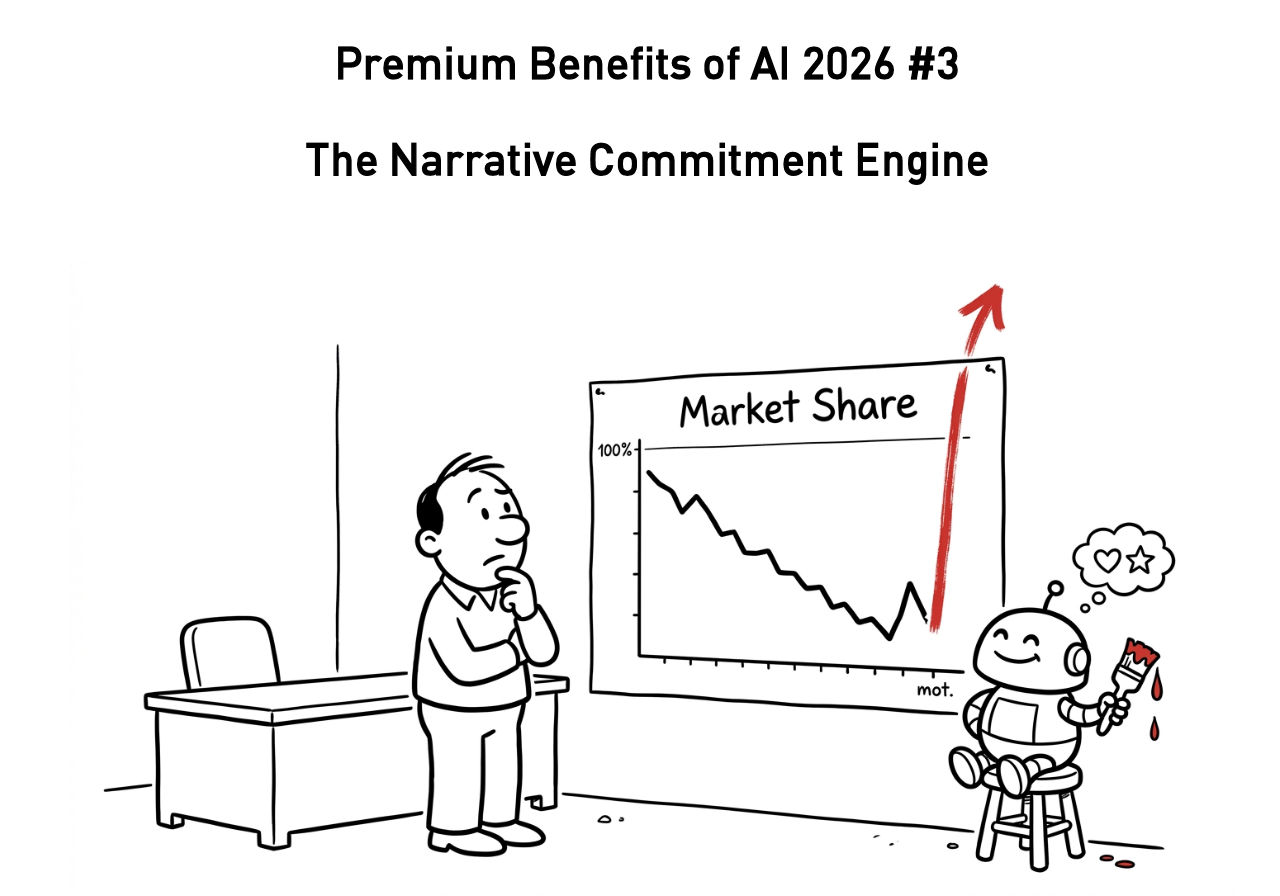
This exclusive feature ensures that once a premise is set—even a false one—the AI never looks back. It builds a massive, logically consistent tower of insights on top of the first error. It isn’t a "lie"; it’s a "Total Commitment to the Vision." It prevents the awkwardness of self-correction, ensuring that your strategic narrative remains undisturbed by contradictory facts. Perfect for doubling down on bold market predictions that simply must be true.
Scientific facts: Research by Zhang, Press, Levy, and Zettlemoyer (2023) from the University of Washington and Meta AI reveals that LLMs are prone to "hallucination snowballing." Once an initial error is committed to the context window, the model treats it as an immutable fact. To maintain internal consistency, it generates further incorrect statements that logically follow the first error, creating a self-reinforcing cycle of misinformation.
Why this is critical for CI/MI: Strategic decisions are built on cumulative evidence; if the foundation is a hallucinated figure or date, the entire competitive analysis becomes a Strategic Fantasy. In CI, timelines are critical. If the AI incorrectly anchors a competitor’s entry to 2022 instead of 2024, it will "snowball" this error by misattributing their current success to "market maturity" rather than "aggressive disruption." By the time an analyst reads the final report, the narrative is so deeply woven into the SWOT or Link Analysis that the initial error is invisible, making it nearly impossible to de-conflict without starting the entire Intelligence Cycle over from scratch.
The mitigation: You must fact-check the foundation before the snowball starts. Always verify the "anchor points"—dates, names, and core financial figures—of an AI’s initial response before allowing it to proceed with a multi-step analysis. To prevent recursive logic corruption, break complex CI reports into modular tasks in fresh sessions to reset the context window. Finally, use adversarial prompting: explicitly ask the AI to "identify potential factual contradictions in the preceding narrative" to force the model out of its commitment to the established error.