

The CTI Automation Trap: Why Patent Scans Are Easy, Strategic Assessments Are Hard
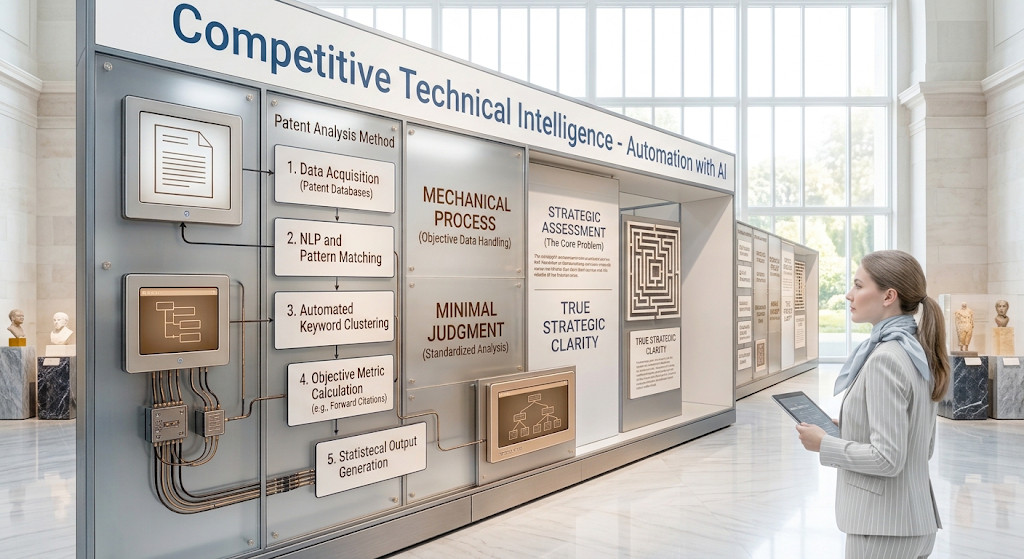
For the past few years, software vendors and AI evangelists have promoted a compelling narrative to Competitive Technical Intelligence (CTI) teams: automate complex technology intelligence, scan patents, build technology roadmaps, identify emerging threats, and deliver strategic assessments ready for the boardroom.
The attraction is obvious. Tasks that once required days of research can now produce results in minutes. But producing an answer quickly is not the same as producing a reliable result.
The less visible cost is the work required to make automation dependable. Tasks must be specified, outputs evaluated, failure modes identified, and quality controls maintained. As the German Federal Office for Information Security (BSI) and TÜV Association report, AI adoption and AI security practices are developing unevenly across German organizations (BSI & TÜV-Verband, 2026). Research on LLM-assisted evaluation also highlights the difficulties of defining and maintaining reliable evaluation criteria (Shankar et al., 2024).
These findings do not establish that automating CTI is inherently uneconomical. They do point to a question that CTI teams should ask before investing in automation: Does the time saved during execution outweigh the cost of making the entire process reliable enough for its intended purpose?
This is where organizations can fall into the CTI Automation Trap. They focus on automating the complete workflow, even when some steps require contextual judgment, difficult-to-define acceptance criteria, or verification that is expensive or impossible to complete conclusively.
The answer is not to avoid AI. Human-led research is imperfect, too. Analysts work with limited time, incomplete evidence, cognitive shortcuts, and unavoidable uncertainty. The objective is to determine which tasks can be automated reliably, which require human judgment, and where the cost of verification outweighs the expected benefit.
Three CTI applications illustrate the difference.
1. Patent Research: A testable automation problem
AI can help retrieve patent records, extract key information, and group documents into an overview of a technology field. These are useful capabilities, but the underlying workflow has been automated for decades. Structured metadata, defined search criteria, and repeatable tasks make much of the process largely mechanical. Performance can be tested, measured, and optimized through repeated cycles, while individual results can be verified against the source material at relatively low cost.
AI is therefore not the original game changer here. Rather, it extends existing automation, handles tasks that were previously harder to automate, and improves performance at the margins. Human verification remains straightforward and follows much the same principles as in manual research: checking what the system found, probing what it might have missed, and repeating the process until the remaining uncertainty is acceptable for the specific decision.
| The AI contribution | The underlying challenge | A proportionate safeguard |
|---|---|---|
| Retrieve and organize patent records | Important material may be missing, even when the results look convincing | Check known relevant examples and review whether the overall coverage is credible |
| Extract key information | Errors can enter the structured data | Check important fields against source records |
| Produce a technology overview | The output may appear more complete than the underlying research warrants | State the scope and limitations of the search |
2. Technology Roadmapping: Uncertainty can be managed, not eliminated
AI can collect technology milestones, summarize research developments, and organize information into a technology roadmap. It can make the preparation of a roadmap faster and help analysts compare large amounts of material.
The difficulty increases when the roadmap moves from describing developments to assessing what will happen next.
A research milestone does not necessarily imply commercial readiness. A stated target is not an achieved outcome. A plausible sequence of developments is not proof that the sequence will unfold as expected.
Making individual steps automatable requires more than breaking a workflow into smaller tasks. For each step, we need to define its inputs and outputs, decide what counts as an acceptable result, and establish how it will be tested. For relatively straightforward tasks, this may be manageable. For judgments about technological progress and commercialization, the criteria might depend on the specific business context and highly difficult to specify.
Looking back at earlier roadmaps and comparing predictions with subsequent developments can provide useful evidence for correctness. But backcasting is not the same as testing a step against a known correct answer. Historical comparisons depend on what was recorded, how the original forecast was defined, and whether the conditions remain comparable.
And finally errors and uncertainty introduced in early stages can propagate through subsequent steps, particularly when later assessments treat earlier outputs as established facts rather than provisional evidence.
| The AI contribution | The underlying challenge | A proportionate safeguard |
|---|---|---|
| Extract milestones and summarize developments | A documented milestone may be mistaken for evidence of readiness | Distinguish reported facts from interpretations |
| Construct a development timeline | A plausible sequence may conceal uncertain assumptions | Make key assumptions and dependencies visible |
| Suggest future technology trajectories | Future outcomes cannot always be tested immediately | Compare with historical cases where possible and revisit assumptions as evidence develops |
AI can accelerate the construction of a roadmap. It cannot remove the uncertainty inherent in anticipating technological change.
3. AI-driven Delphi Panels: Making uncertainty explicit
AI can simulate expert perspectives, generate arguments, and summarize areas of agreement and disagreement. These capabilities may be useful when exploring alternative futures or preparing questions for human experts.
But an AI-generated consensus is not equivalent to a consensus among independent human experts. Simulated personas may draw on overlapping information and share the same underlying assumptions and model biases. The result can look coherent and systematic while merely reinforcing a mainstream view.
Testing this is particularly difficult. Analysts must examine not only whether conclusions are consistent, but whether the perspectives are genuinely diverse and the underlying assumptions hold up to scrutiny. Varying prompts and evidence, challenging conclusions, and comparing results with independent expert assessments can expose weaknesses, but require substantial human judgment and do not guarantee that shared blind spots have been eliminated.
The paradox is that validating an AI-generated consensus may require analysts to reconstruct and challenge the reasoning behind it—only to discover that the apparently robust conclusion was wrong.
| The AI contribution | The underlying challenge | A proportionate safeguard |
|---|---|---|
| Generate simulated expert perspectives | Different personas may share the same underlying biases | Treat simulated perspectives as exploratory inputs, not independent expert evidence |
| Summarize agreement | Apparent consensus may depend on shared assumptions | Examine important disagreements and test sensitivity to changed inputs |
| Produce forecasts or early warnings | There may be no definitive answer available at the time of assessment | Record assumptions and uncertainty; compare against later outcomes when possible |
The goal is not to eliminate uncertainty, but to understand how much confidence the assessment warrants and what additional evidence a decision requires. Establishing this can demand substantial human judgment, particularly when shared assumptions and blind spots are difficult to detect.
The hidden cost: Checking the results
These examples point to a broader issue. Automating a complex analytical workflow is not simply a matter of asking an AI system to perform the steps a human analyst would perform.
Even when a task appears mechanical, reliable automation may require a level of specification similar to software development. Inputs, outputs, and acceptance criteria must be defined. Tests must be created, run, and maintained. Failure cases need to be considered, and the process may need to be revised as the task or underlying information changes.
This work can be expensive. For some CTI applications, the initial specification and validation effort may approach or exceed the cost of manual execution, particularly when the workflow is used for a one-time decision. For recurring tasks, however, that investment may pay off over time.
A further complication is that not every analytical task has a clear expected answer. Some aspects can be tested against known results; others require assessing consistency, robustness, assumptions, and the quality of the reasoning itself.
Humans are not the perfect baseline
This is not an argument for holding AI to an impossible standard while assuming that human analysts are consistently thorough.
Manual CTI research also relies on shortcuts. Analysts prioritize some sources over others, stop searching when additional effort seems unlikely to change the conclusion, and make judgments with incomplete evidence. Exhaustive verification is often impractical, whether the work is performed by a person or a machine.
The appropriate comparison is therefore between realistic workflows, not between imperfect AI and idealized human research.
An AI-supported process may be worthwhile even when it cannot guarantee completeness or correctness. It may save time, improve consistency, widen the range of evidence considered, or allow analysts to explore more alternatives. But those benefits must be weighed against the effort required to specify, test, supervise, and maintain the process—and against the consequences if it fails.
A more useful question for CTI automation
Instead of asking, “Can AI perform this task?”, organizations should ask:
- Can we define the task well enough to automate it? Are its inputs, outputs, and acceptance criteria sufficiently clear?
- Can we test it meaningfully? Do we have credible examples, expected outcomes, or other ways to assess performance?
- What will verification cost? Will the time saved justify the effort required to check and maintain the automated process?
- What remains uncertain? What can our tests establish, and what can they not establish?
- What happens if the result is wrong? Is the task exploratory and reversible, or could an error materially affect a strategic decision?
- Which parts of the workflow can be automated reliably and economically? Does the entire process need to be automated, or only specific steps?
These questions require a realistic understanding of what the process can establish, where its limitations lie, and how much uncertainty is acceptable for the specific business context and decision.
Conclusion: Measure the whole process, not just the speed of result generation
AI can make many CTI activities faster. But the cost of producing an answer is only one part of the equation. The cost of specifying the task, testing its performance, checking its outputs, maintaining the process, and managing the consequences of error also matters.
Sometimes, the investment will be worthwhile. Sometimes, a limited form of automation with human oversight will be better than attempting to automate an entire workflow. And sometimes, the specification and verification effort will make manual work the more practical choice.
The CTI automation trap is to measure success by how quickly AI produces an answer, rather than by what it costs to make the overall process reliable enough for its intended use.
The objective is not perfect automation. It is better intelligence: produced with proportionate effort, tested as far as the evidence allows, and used with an honest understanding of what remains uncertain.
Any CI/MI Practitioner that wants to automate Competitive Technical intelligence requires a deep understanding of the decision context, the business context and the method automated including its specific strength and weaknesses. Education, experience and AI literacy are key to success.
References
-
BSI & TÜV-Verband (2026). KI-Sicherheitsstudie 2026. German Federal Office for Information Security and TÜV Association. Study and report.
-
Lorenz, T., & Fritz, M. (2026). Scalable Delphi: Large Language Models for Structured Risk Estimation. arXiv:2602.08889. https://arxiv.org/abs/2602.08889
-
Shankar, S., Zamfirescu-Pereira, J. D., Hartmann, B., Parameswaran, A. G., & Arawjo, I. (2024). Who Validates the Validators? Aligning LLM-Assisted Evaluation of LLM Outputs with Human Preferences. arXiv:2404.12272. https://arxiv.org/abs/2404.12272
-
Bill, T. (2026). How to Get Started with AI for Strategic Analysis Techniques: A CI/MI Practitioner's Guide for Using AI in CI/MI. Institute for Competitive Intelligence. White paper
Want to stay informed?
- Follow our LinkedIn Page or
- Register for our Newsletter
- And follow our LinkedIN Newsletter