

Outgunned by AI: Asymmetric Information Warfare and Its Implications for Competitive and Market Intelligence
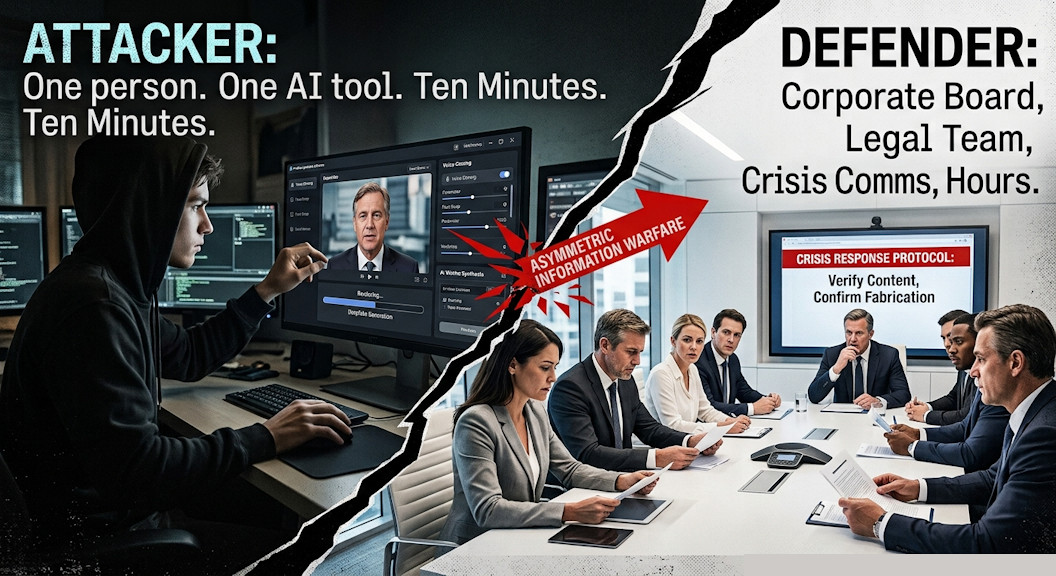
One person. One AI tool. Ten minutes. That's now enough to generate a fake video, a synthetic voice clip, or a fabricated news story convincing enough to move a stock price, spook investors, or unravel a reputation built over decades.
Your side needs a legal team, a crisis communications unit, a verification process, and hours — often days — to catch up.
That gap is the new asymmetry, and it's exactly why the World Economic Forum's Global Risks Report 2026 places misinformation and disinformation among the top global risks facing the world over the next two years — driven, in the report's own words, by "AI-generated deepfakes." Based on a survey of more than 1,300 experts across government, business, academia, and civil society, it now ranks alongside geoeconomic confrontation and cyber insecurity.
The report names precisely what tipped the scales:
"No longer requiring a niche skill set, easy-to-use interfaces to large-scale artificial intelligence models have already enabled an explosion in falsified information and so-called 'synthetic' content, from sophisticated voice cloning to counterfeit websites."
Why companies are the exposed side of this asymmetry
Governments have started building defenses — election-disinformation monitoring, platform cooperation, media literacy campaigns. Companies largely haven't. As the WEF notes in a related analysis, businesses are effectively undefended targets: they're built to be visible and trusted, which is exactly what makes them easy to attack. And unlike political disinformation, which erodes trust over months, a fabricated video can move a stock price in minutes — long before legal or communications teams can even confirm it's fake.
The WEF cites that 42% of companies now name deepfake-driven manipulation as their top AI-related risk, and that roughly half of all businesses faced a deepfake-related attack in 2024 alone.
A recent case in point
In January 2026, the Bombay Stock Exchange had to issue an urgent public warning after a highly realistic deepfake video of its own CEO circulated on social media and WhatsApp — showing him offering "exclusive" stock tips and promising extraordinary returns. The BSE was forced to publicly confirm the video was fabricated and warn investors not to act on it. This wasn't fraud in the classic sense of stealing funds directly — it was a direct attack on market integrity, using the institution's own credibility as the weapon.
For Competitive/Market Intelligence professionals, the asymmetry is the job now.
CI/MI has traditionally been about knowing more than the competition. Increasingly, it's about recognizing — and responding to — deliberate opinion-shaping before it hardens into market reality for your customers, investors, and partners. Outgunned doesn't have to mean outmaneuvered.
This is exactly what the ICI-36 Workshop: Ethical Information Warfare is built for. You'll learn the communication models, tactics, and strategies used to shape opinion — ethically — both to defend your organization's reputation and to strengthen its market position. The day includes hands-on case studies covering both attack and defense scenarios.
References:
World Economic Forum. (2026, January 14). The Global Risks Report 2026 (21st ed.).
https://www.weforum.org/publications/global-risks-report-2026/
