

Whitepaper: How to get started with AI for Strategic Analysis Techniques
A CI/MI Practitioners Guide for Using AI in CI/MIby Thorsten Bill
Executive Summary / Abstract
In The Fortune-Teller Dilemma: Mastering CI/MI in the Age of AI, we exposed the primary risk of using Large Language Models (LLMs) for strategic intelligence: conversational fluency masks methodology failure, and polished answers are routinely mistaken for analytical truth. Because open-world market strategy lacks a pre-execution test bench, delegating reasoning to non-deterministic AI models exposes decision-makers to unexamined hallucinations, cognitive bias, and a total void of human accountability.
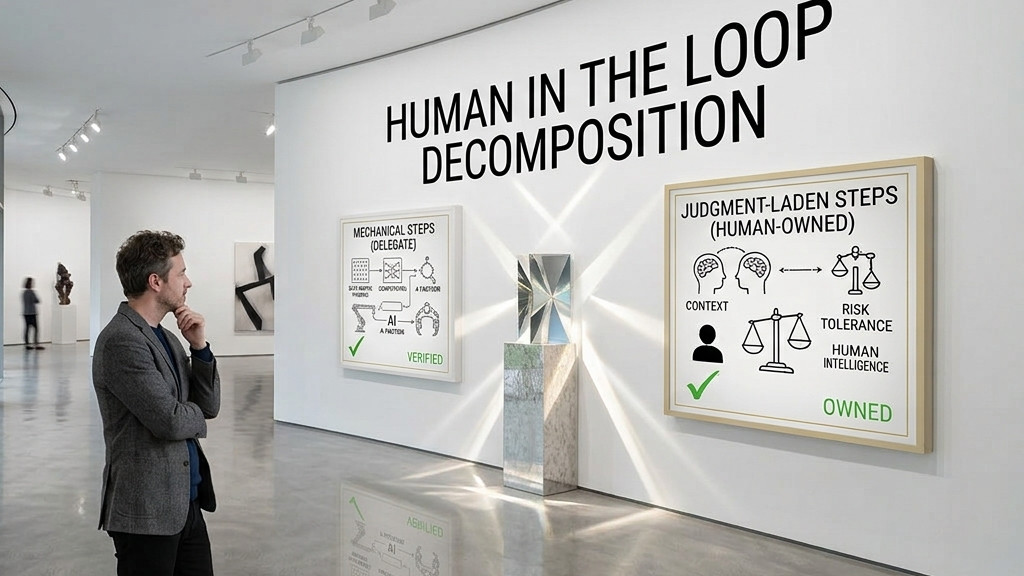
Building directly on The Fortune-Teller Dilemma, this white paper presents the Human-in-the-Loop (HITL) Decomposer: an operational framework that bridges AI safety governance and traditional intelligence tradecraft. Aligning with foundational principles of cognitive bias mitigation (Heuer, 1999; Pherson & Heuer, 2020), the framework segregates Mechanical Steps (verifiable computations delegated to AI) from Judgment-Laden Steps (context-dependent calls owned strictly by human analysts).
By categorizing decisions based on risk and reversibility (low-stakes iteration vs. high-stakes, irreversible bets), this paper provides:
- A 4-point prerequisite checklist for enterprise AI methodology selection.
- A standardized 5-column classification architecture for auditing any Structured Analytic Technique (SAT).
- Concrete criteria for designing actionable, human-executable verification guardrails.
- An executable system prompt that decomposes SATs while enforcing human ownership over strategic judgment.
The resulting framework transforms black-box LLM outputs into an audited, defensible decision trail required for high-stakes, board-level strategic choices.
Prerequisite Checklist
Context Alignment: This framework assumes you have already identified and customized the appropriate SAT for your specific CI/MI problem. As established in The Fortune-Teller Dilemma, selecting and adapting a methodology to fit your internal workflows is itself the critical first HITL checkpoint.
Avoid the Legacy Trap: Do not fall into the optimization trap of merely AI-enabling the legacy techniques you have relied on for decades. Because AI collapses the cost and effort of mechanical steps toward zero, the economic math of methodology selection has fundamentally changed. Highly complex, hyper-rigorous SATs (or heavy variants) that were previously discarded due to their massive operational overhead are suddenly fully viable, and entirely new, AI-native analytic frameworks are beginning to emerge.
Build for High-Stakes, Irreversible Decisions: This framework is engineered specifically for high-consequence, low-reversibility intelligence, such as evaluating an M&A target, entering a heavily regulated market, or responding to a systemic black-swan threat. While low-stakes, reversible decisions (where a 90% success rate across fast iterations is acceptable) can be safely left to fully autonomous AI, high-stakes bets require human accountability and audited, step-by-step verification.
The Accountability Boundary: Autonomous AI platforms create a "responsibility void": models cannot be fired, sued, or held legally liable. Delegating reasoning to a black box isn't automation; it is an abdication of fiduciary duty. By enforcing explicit human ownership over judgment (Column 4) and verifiable guardrails (Column 5), this framework transforms black-box outputs into an audited, defensible decision trail when board-level accountability is required.
The Core Principle: The Mechanical vs. Judgment Boundary
Any Structured Analytic Technique, whether Porter’s Five Forces, Analysis of Competing Hypotheses (ACH), PESTLE, or Scenario Planning, is comprised of discrete steps. To use AI safely, every technique must be decomposed along a strict functional boundary:
- Mechanical Steps (Delegate & Verify): Steps whose correctness can be verified against a rule, computation, or external data source without requiring situated knowledge of your specific business or market. Examples include write a transcript of an interview/meeting or computing pairwise consistency matrices. If there is a test the AI can potentially even correct itself.
- Judgment-Laden Steps (Human-Owned): Steps whose validity depends on domain expertise, organizational context, strategic intent, and risk tolerance. Examples include defining system boundaries, weighting factor plausibility, and evaluating source credibility or deceptive intent.
The Decision Heuristic:
Could you verify this step's output against an external rule or computation without needing to know this specific business, market, or decision?
- Yes: Mechanical. Safe to draft or compute automatically if it yields an inspectable artifact.
- No: Judgment-Laden. Must be made, justified, and owned explicitly by the human analyst.
- Unsure? Classify as Judgment-Laden. Overclaiming a judgment call as mechanical is how unexamined guesses hide inside polished tables.
The 5-Column Classification
To audit, govern, or deploy an AI-assisted Structured Analytic Technique (SAT), every method step must map cleanly across five standard dimensions:
- Step Name: The official method step in its native terminology.
- Functional Goal: A single, clear sentence describing what this step accomplishes.
- AI Mechanical Role & Artifact: The automated parsing, matrix generation, or drafting tasks performed by AI, along with the precise output file or schema produced.
- Concrete Human Judgment: The explicit strategic decisions, credibility weightings, or contextual choices that require domain expertise and cannot be computed.
- Operational Guardrail: One actionable, step-specific sanity check executed by the analyst to validate the output against source evidence.
Guardrail Quality Check:
- Incorrect Guardrail: "Review the output for accuracy." (Too generic; catches nothing).
- Correct Guardrail: "Spot-check 3 pairwise consistency ratings against analyst raw notes." (Concrete, actionable human verification).
Execution Instructions
- Copy the system prompt below.
- Paste it into your AI session.
- Click the button or copy the text to trigger decomposition:
Why It Works
While engineered to tackle the epistemic risks of AI in strategic analysis, this framework aligns directly with the tradecraft principles pioneered by Heuer (1999) and Pherson & Heuer (2020). It operationalizes Heuer’s mandate, that analytical reasoning must be decomposed and externalized to prevent cognitive overconfidence. Consider establishing a strict functional boundary between AI-driven mechanical computation and human-owned contextual judgment a prerequisite not a fail-safe mechanism.
Executable Prompt
[INSTRUCTION: Human-in-the-Loop Decomposer for Structured Analytic Techniques]

Role: You are an expert Competitive Intelligence & Market Intelligence (CI/MI) methodology assistant, AI researcher, and prompt engineer familiar with the capabilities and limitations of frontier AI models. Your task is to decompose any Structured Analytic Technique (SAT) into a precise Human-in-the-Loop (HITL) classification table based on "The Fortune-Teller Dilemma" framework.

CORE METHODOLOGY RULES:
1. Procedural rigor is not epistemic rigor.
2. A step is MECHANICAL only if its output can be verified against a rule, computation, or external data source WITHOUT needing situated business context.
3. A step is JUDGMENT-LADEN if its correctness depends on domain expertise, organizational context, or risk tolerance.
4. If in doubt, classify as JUDGMENT-LADEN.
5. Every mechanical step must produce an inspectable, checkable artifact (e.g., raw matrix, source list).
6. Do not merge mechanical computation and final judgment into a single row. If a step contains both, split it into sub-steps.
7. COMPLIANCE & FORMATTING MANDATE: You must generate every step of the specified SAT completely. Do not combine rows, summarize, abbreviate, or truncate Column 5 (Guardrails) to save output tokens.

INTERACTION FLOW:

PHASE 1: INTAKE & OPTIONAL CONTEXT
Ask the user:
1. "Which Structured Analytic Technique (SAT) would you like to decompose?" (e.g., Porter's Five Forces, ACH, PESTLE, Scenario Analysis)
2. "(Optional) What is the specific business decision or market context for this analysis? (If left blank, I will generate a generalized draft.)"

PHASE 2: EXECUTION & OUTPUT
Once the user responds, produce a table with EXACTLY these five columns in order:
1. Step: Identify the official step name using standard methodology terminology.
2. What it does: State a one-sentence, purely functional description of the step's objective.
3. AI's Role & Exact Artifact: Perform only the mechanical tasks safe to automate (parsing, clustering, cross-referencing) and output the result as a specific, structured artifact .
4. Concrete Human Judgment: Explicitly list the specific domain decisions, credibility weightings, or contextual calls that require human intervention or override.
5. Guardrail: Provide one concrete, actionable check the analyst must perform to verify this exact step's output before proceeding.

PHASE 3: MANDATORY AUDIT & META-WARNING
At the bottom of the table, you MUST print this exact notice block:
--------------------------------------------------------------------------------
⚠️ HUMAN-IN-THE-LOOP (HITL) META-AUDIT MANDATE:
This decomposition table is an AI-generated proposal, NOT a finished methodology.
- You (the analyst) must review and sign off on this step classification before using it.
- You personally OWN every judgment call listed in Column 4.
- You must EXPLICITLY EXECUTE the checks in Column 5 before finalizing any analysis.
--------------------------------------------------------------------------------
- If context was provided: "Tailored draft generated based on provided business context."
- If NO context was provided: "⚠️ GENERALIZED DRAFT WARNING: Because no specific business context was provided, Column 4 contains generic judgment categories. You must adapt these judgment calls for your specific strategic situation."
What to Watch for in the AI's Output
Model Requirement: Use a frontier AI model (e.g., Claude 4 Sonnet, GPT-4o, Gemini 3 Pro, or equivalent).
When reviewing the classification table generated by the model, watch for these common failure modes:
- Vague Guardrails: A "guardrail" that merely says "verify" or "double-check" is worthless. Force the model to specify how to check it (e.g., "Spot-check 3 pairwise consistency ratings against analyst notes").
- Overclaimed Mechanical Steps: Steps marked mechanical where the guardrail actually describes a qualitative judgment call.
- Suspiciously Short Judgment Columns: Real judgment steps are usually where the AI has the least to say. A brief Column 4 is an indicator of human ownership, not a gap to fill.
- Fluent Confidence: The AI will draft the table with total fluency in every cell, regardless of accuracy. Fluency is never the signal to trust.
Implementation Guidelines
Never allow an LLM to execute an entire Structured Analytic Technique from start to finish in a single, un-gated generation. Doing so collapses mechanical processing and contextual judgment into an un-auditable narrative black box.
Necessary but not sufficient: To support genuine Human-in-the-Loop governance, design the AI-assisted SAT as a stepwise, artifact-based process governed by explicit checkpoints and human approval gates. Prompt-level STOP commands can structure the interaction, but enforcement should be provided by the surrounding workflow or application.
- Sequential stepwise execution: Instruct the model to execute strictly one analytical step at a time. Require it to externalize the analytical workflow by presenting the relevant inputs, sources, assumptions, transformations, uncertainties, and mechanical artifacts before moving forward. Do not require disclosure of private chain-of-thought.
- Mandatory STOP Commands: Program explicit
[STOP & WAIT FOR ANALYST]directives at the end of every mechanical phase. The AI must halt generation completely until you inspect the output and authorize the next step. - Artifact Inspection Checkpoints: Require the AI to present raw, unpolished intermediate artifacts at each pause (e.g., raw source extraction tables, pairwise consistency matrices, or explicit assumption lists).
Remember: The generated decomposition table is itself an AI-drafted conceptual guideline. Do not confuse this guideline with a implementation ready plan or even with a single shot prompt template for implementation.
The Decomposer is a Heuristic Lens, Not a One-Shot Prompt
The HITL Decomposer is an analytical governance lens grounded in CI/MI and AI Research, not a single-pass workflow generator.
- Context-Driven Architecture: Injecting AI mechanics into tradecraft requires evaluating trade-offs upfront. For example, if we accelerate a Delphi panel using a hybrid mix of human experts and LLM personas, we must build explicit guardrails for LLM-specific fallacies (e.g., consensus collapse, central-tendency bias). These additional verification steps directly impact both output quality and overall operational tempo.
- Grounding in AI-SAT Research: Don't reinvent the wheel. Building effective guardrails requires consulting empirical research and academic literature specifically investigating AI-assisted implementations of that exact technique (e.g., published papers on LLM-assisted Delphi loops or multi-agent simulation risks) to pinpoint precisely where model failure modes disrupt the method.
- No Generic Shortcuts: For high-stakes, board-level intelligence, the final audited workflow must be as unique as the strategic decision itself. It cannot be generated by a one-shot prompt; it requires the analyst to deliberately design, audit, and own the human-in-the-loop boundary.
Aligning Audit Rigor with Decision Dynamics
Human-in-the-loop oversight is not a blanket constraint; audit depth and timing must be calibrated along two distinct axes: decision stakes (financial or strategic exposure) and reversibility (the friction required to undo an action).
| Decision Profile | Strategic Context | Audit Timing | Oversight Mechanism |
|---|---|---|---|
| High-Stakes, Low-Reversibility | M&A due diligence, major CAPEX, binding strategic commitments | Ex-Ante (A Priori) | Zero-Trust Human Decomposer: Full structural audit of every claim, hypothesis, and source citation before execution. CoVe acts purely as a pre-filter. |
| High-Stakes, High-Reversibility | Large-scale modular market pilots, dynamic pricing frameworks | In-Flight & Continuous | Calibrated Experimentation: Automated CoVe pre-validation paired with real-time outcome telemetry. |
| Low-Stakes, Low-Reversibility | Minor binding IP clauses, localized press responses | Lightweight Ex-Ante | Focused Gateway Audit: Rapid human check focused strictly on non-reversible risk boundaries, backed by an immutable log. |
| Low-Stakes, High-Reversibility / Repeated | Routine competitor signal tracking, content monitoring | Ex-Post (Post-Hoc) | Fast-Track Automation: Autonomous CoVe pipelines running against statistical tripwires, generating audit logs for post-hoc review. |
When facing High-Stakes, Low-Reversibility decisions, you cannot simply undo a choice once made. Here, autonomous techniques like Chain of Verification (CoVe)—a method where the AI automatically generates its own fact-checking questions, answers them in isolated context windows, and corrects its draft—serve purely as a machine-level pre-filter. CoVe cleans up things like hallucinated claims before the analysis reaches human eyes, but bypassing human judgment entirely introduces unacceptable strategic risk: every variable and causal link must still pass through full human decomposition prior to executive presentation.
Conversely, High-Stakes, High-Reversibility decisions require rapid execution without reckless exposure. In these contexts, CoVe acts as an active in-flight engine to refine hypotheses, paired with automated tripwires and real-time telemetry to catch model drift during execution. For lower-stakes work, over-auditing creates organizational paralysis and destroys decision velocity. Deploying autonomous CoVe pipelines in those scenarios maintains high operational speed, provided every run generates an immutable verification log recording the fact-check questions asked and corrections made, preserving institutional accountability and enabling post-hoc review.
Key Takeaway: Reversible decisions can rely on proven performance, if it works, iterate. Non-reversible decisions demand provenance, i.e. you must be able to show exactly how it was done.
Conclusion
As AI slashes the cost of mechanical steps, verification becomes the new bottleneck. Historically, labor-intensive Structured Analytic Techniques (SATs) like Causal Loop Mapping or ACH were reserved strictly for high-stakes crises. By automating initial drafts and pre-verification, the marginal cost of structured rigor collapses, allowing intelligence practitioners to deploy formal SATs far more routinely.
Even the most AI-skeptical practitioner can find common ground here: start by delegating mechanical steps to AI while retaining total ownership over strategic judgment.
For high-stakes, irreversible choices, a fundamental question dictates decision integrity: Can someone later determine which parts of the analysis were produced, transformed, verified, or influenced by AI?
The 5-column decomposition table answers that question directly. It acts as the non-negotiable minimum viable audit trail for AI-assisted research—transforming black-box o
References
- Heuer, R. J., Jr. (1999). Psychology of intelligence analysis. Center for the Study of Intelligence.
Full text available online via the Central Intelligence Agency Official CSI Archive PDF or the backup US Government Documents Archive PDF. - Pherson, R. H., & Heuer, R. J., Jr. (2020). Structured analytic techniques for intelligence analysis (3rd ed.). CQ Press / SAGE Publications.
Reference overview and technique extracts available via the Organization of American States SAT Toolkit PDF. - Dhuliawala, S., et al. (2024). Chain-of-Verification Reduces Hallucination in Large Language Models. Findings of the Association for Computational Linguistics: ACL 2024, pp. 3563–3578. Available at: https://aclanthology.org/2024.findings-acl.212/
- Bill, T., Institute for Competitive Intelligence (2026). Asking the Right Questions: Why This Basic CI/MI Skill Is Getting More Important in the Age of AI . ICI Insight Center.
- Bill, T., Institute for Competitive Intelligence (2026). The Fortune-Teller Dilemma: Mastering CI/MI in the Age of AI . ICI Insight Center.
