

Foresight with AI in 2026: AI-Powered Causal Loop Analysis
by Thorsten Bill
As Competitive and Market Intelligence (CI/MI) practitioners, we face a compounding paradox: blind spots are expanding faster than ever, yet our leadership demands faster strategic clarity on lower budgets.
Traditional scenario planning remains a powerful approach for navigating deep uncertainty. However, many scenario processes are workshop-intensive and can be difficult to scale for today's faster-moving market cycles.
AI can accelerate important parts of scenario planning. It can help identify signals, structure assumptions, generate alternative futures, challenge established perspectives, and explore complex interactions. However, AI does not eliminate blind spots or replace strategic judgment. Its value depends on how well it is embedded within a transparent methodology, supported by evidence, and subject to human validation.
The emerging landscape can be understood through three distinct architectures for AI-enabled scenario planning. They represent increasing levels of AI integration, from conversational assistance, through structured scenario-management pipelines, to AI-simulated expert panels combined with formal computational analysis.
The Three Architectures
Architecture 1: Conversational Co-Pilots & Cognitive Acceleration
proposed by Shinkle, Gujarati & Sharry (2026)
- The Concept: Uses Generative AI as an assistant in prompt-based scenario work. Structured prompting can help explore and draft alternative futures. Approaches include sequential prompting, scenario testing, and self-critique. Human judgment remains central.
- How it Works: LLMs can help surface trends and weak signals, explore alternative interpretations, challenge assumptions, and generate preliminary scenario narratives. The human team remains responsible for evaluating evidence, testing assumptions, interpreting implications, and making strategic choices. The approach therefore shifts effort from some forms of content generation toward evaluation and judgment rather than transferring strategy to the AI.
- Primary Advantage: Low implementation friction, rapid exploration, and the ability to make structured scenario thinking accessible to a broader range of teams.
Architecture 2: Systemic Software Pipelines & Knowledge Backbones
Proposed by Knepler et al. (2026)
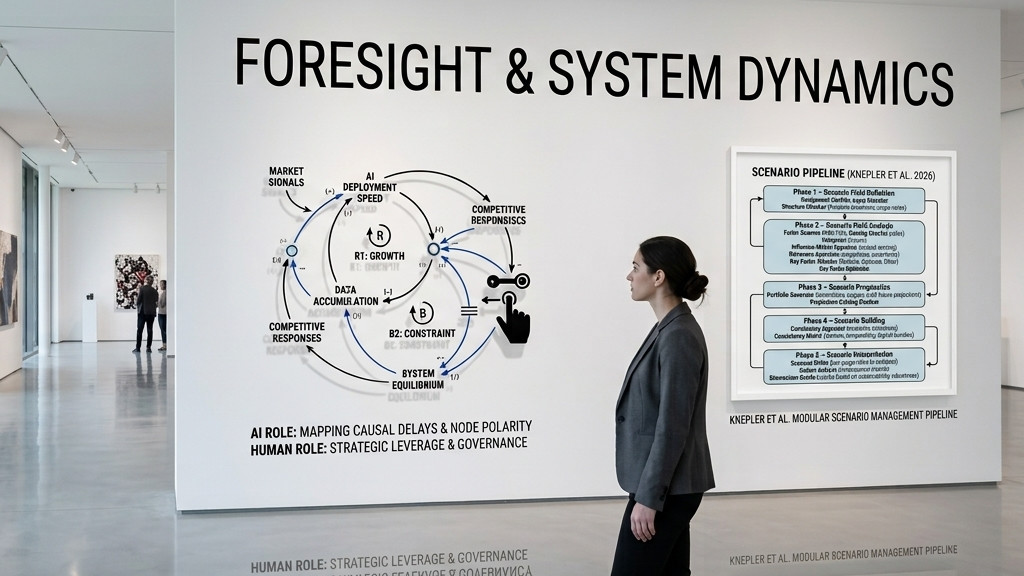
- The Concept: Moves beyond individual chat sessions toward an integrated scenario-management architecture in which AI supports established scenario-planning methods. The proposed approach emphasizes modularity, explainability, reuse, provenance, and human oversight.
- How it Works: The proposed architecture combines a simplified Scenario Wizard with an expert environment and a shared knowledge backbone. The knowledge layer can retain entities such as factors, projections, scenarios, evidence, rationales, and decision links together with their relationships and provenance. AI is intended to support activities across the scenario-development process, while explicit human checkpoints provide validation and governance. Importantly, this is a proposed architecture rather than a fully implemented and validated enterprise system.
- Primary Advantage: Greater structural consistency, traceability, explainability, and potential reuse of scenario knowledge across projects and over time.
Architecture 3: AI-Simulated Expert Panels & Computational Scenario Analysis
proposed by Ross & Ross (2026)
- The Concept: Uses an LLM to simulate multiple expert or stakeholder perspectives and combines the resulting elicitation with formal Cross-Impact Balance (CIB), multi-criteria analysis, and stochastic scenario analysis. The approach explores how different assumptions and stakeholder perspectives can interact within a socio-technical system.
- How it Works: Distinct expert or stakeholder roles can be assigned to an AI-simulated panel, e.g. a regulator, competitor, consumer, or technology stakeholder. The panel contributes to the identification of descriptors, alternative states, and cross-impact judgments. Computational CIB analysis can then identify internally consistent configurations, while stochastic structural and dynamic shocks can be used to explore pathway resilience over time. The approach can also translate selected scenario pathways into quantitative model inputs, subject to domain-specific calibration and validation.
- Primary Advantage: Scalable exploration of multiple stakeholder perspectives and systematic stress-testing of complex scenario pathways under uncertainty.
Structural Comparison
| Dimension | Architecture 1: Conversational Co-Pilots | Architecture 2: Scenario-Management Pipelines | Architecture 3: AI-Simulated Panels |
|---|---|---|---|
| Primary Medium | LLM interfaces, prompt workflows, templates and structured conversations. | Integrated scenario-management environment with a shared knowledge backbone. | LLM-simulated expert panels combined with CIB, MCDA and stochastic analysis. |
| Methodological Basis | Prompting, testing, scenario exploration and human interpretation. | Structured scenario methodology, knowledge representation, provenance and HITL governance. | CIB-based consistency analysis, expert elicitation, MCDA and stochastic/dynamic scenario analysis. |
| AI Role | Cognitive assistant and scenario-generation accelerator. | Embedded workflow component supporting structured scenario activities. | Simulated expert/stakeholder panel combined with computational scenario analysis. |
| Human Role | Interpreter, evaluator and decision-maker. | Reviewer, validator and governance authority at defined HITL points. | Defines boundaries, roles and assumptions; validates outputs and model behavior. |
| Knowledge Persistence | Usually limited to conversations, prompts and project artefacts. | Explicitly designed for reusable, provenance-aware scenario knowledge. | Primarily represented through scenario configurations, panel outputs and model parameters. |
| Quantification | Limited; primarily qualitative and narrative. | Structured, but the proposed architecture is not yet empirically validated as a quantitative forecasting system. | Explicit computational analysis with potential translation into quantitative scenario/model inputs. |
| Implementation Effort | Low; can begin with existing LLM tools and prompt workflows. | Medium to high; requires workflow, knowledge-model and software integration. | High; requires formal model design, orchestration, computation and validation. |
Practical Guidance: When to Use What
- Use Architecture 1 (Conversational Co-Pilots) when you need rapid qualitative exploration, e.g. an executive briefing, strategy sprint, early-stage scenario exercise, or ad-hoc war-gaming session. It is particularly useful when speed and low implementation friction are important.
- Use Architecture 2 (Scenario-Management Pipelines) when scenario work needs to become a repeatable organizational capability with explicit methodology, provenance, reusable knowledge, explainability, and human governance. It is particularly relevant for formal strategy, innovation roadmapping, and competitive-risk processes that need continuity across projects.
- Use Architecture 3 (AI-Simulated Expert Panels) when the problem involves interacting variables, multiple stakeholder perspectives, socio-technical change, or the need to stress-test pathways under uncertainty. Because this approach remains an emerging research direction, domain validation and sensitivity testing are essential.
Navigating Evolving Frontiers
As CI/MI professionals, we should approach these developments as an expansion of the scenario-planning toolkit rather than as a replacement for established foresight practice.
The prompt-based workflow described by Shinkle, Gujarati & Sharry demonstrates how Generative AI can accelerate scenario exploration while retaining an important role for human judgment. Its strongest near-term value is therefore as a cognitive accelerator rather than as an autonomous strategy engine.
The architecture proposed by Knepler et al. moves scenario planning toward a reusable organizational process. It builds on established scenario-planning methods and adds modular components, a shared knowledge backbone, provenance, explainability, and human oversight. This makes it the most structured of the three architectures and the closest to an operational scenario-management system. Its proposed architecture still needs implementation and validation in real-world settings.
Ross & Ross point toward a further development of AI-enabled scenario planning. Their approach combines established CI/MI techniques such as expert elicitation and Cross-Impact Balance analysis with AI-simulated expert and stakeholder panels. It also introduces stochastic analysis and quantitative scenario pathways. This creates a bridge between qualitative foresight and computational scenario analysis. The approach still requires validation against real-world problems, but rapid advances in AI could accelerate its transition from research to operational use.
Summary
AI is accelerating scenario development. It can support more stages of the process, from research and analysis to scenario generation and testing. This makes scenario development faster and more iterative, while human judgment remains central.
References
- Knepler, J., Seidenberg, T., Grigoryan, K., Asmar, L., & Dumitrescu, R. (2026). AI-based scenario management for SMEs: The need for modular, explainable and reusable foresight pipelines. Proceedings of the Design Society. Cambridge Core.
- Ross, A. G., & Ross, A. M. (2026). AI-Simulated Expert Panels for Socio-Technical Scenarios and Decision Guidance. Preprint, arXiv:2603.29470. arXiv / ResearchGate.
- Shinkle, G. A., Gujarati, C., & Sharry, P. (2026). Scenario analysis in the AI era: Redefining human involvement. Organizational Dynamics, 55, 101197. ScienceDirect. See also the practitioner summary at UNSW BusinessThink.
- Institute for Competitive Intelligence (2025). Eight Ways How AI Can Transform Your Foresight Practices. Institute for Competitive Intelligence.
Want to stay informed?
- Follow our LinkedIn Page or
- Register for our Newsletter
- And follow our LinkedIN Newsletter